Warning: This review contains spoilers.
First love, loneliness, the craving for connection, and the act of questioning your own life—these are just a few of the themes explored in this film. All of this unfolds in what is arguably one of the greatest films in Asian cinema.
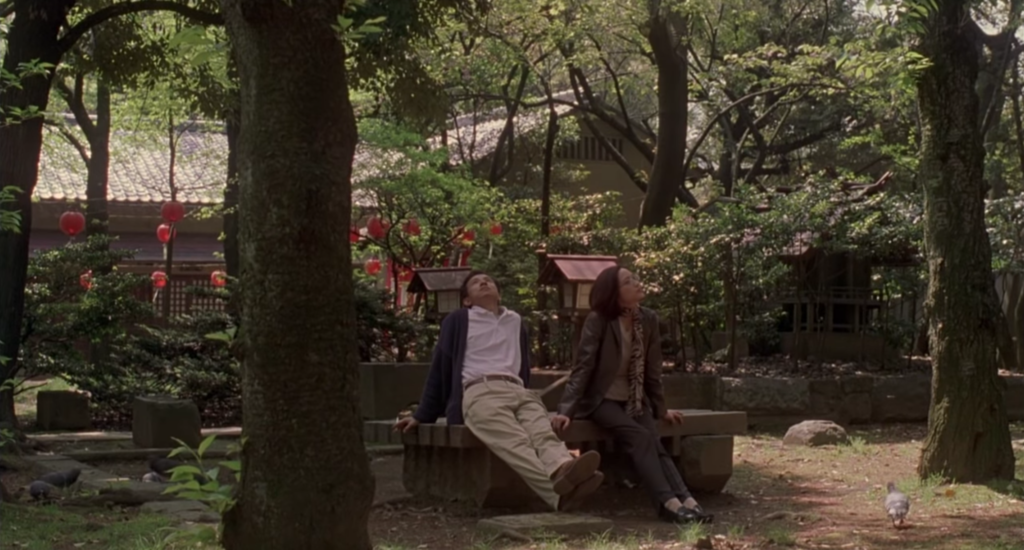
Yi Yi, released in 2000 and directed by Edward Yang, is an almost three-hour film that focuses on the Jian family, whose lives shift dramatically when the grandmother falls ill. Each member of the family then embarks on their own journey—trying to escape, rediscover themselves, and even revisit the past—while ultimately exploring the truth of life itself.
This film beautifully examines and reflects on different aspects of life across generations. For example, Min-Min, the central mother figure in the story, chooses to leave her family behind and temporarily live in a temple. This highlights her inability to embrace the current situation; with her mother (Grandma) being ill, she turns her back and runs away instead. At the same time, we witness her sadness, anger, and despair all at once, every time she sits beside Grandma, trying to speak to her.
Alongside Min-Min’s storyline, we are also shown her dynamic with her husband, NJ. They are not abusive toward one another—in fact, they do care about each other—but the emotional exhaustion between them is deeply felt. When Min-Min breaks down over her struggle to open up to her mother, NJ is clearly unable to console her in any meaningful way. They are together, but never truly connected.
From here, the writing of the film only becomes stronger. NJ, on the other hand, runs into his first love from high school, Sherry. The energy between them is the complete opposite of what we see between NJ and Min-Min. NJ and Sherry reconnect and relive their love for a second time. The butterflies return, the sparks reignite—but the question remains: will the ending be different this time?
It would be foolish to think the answer is yes. NJ suppresses everything his feelings and heart are telling him and ultimately chooses to repeat the same ending. After all, when risk, responsibility, and duty are all waiting at home, is choosing love even worth it?
The storytelling of this family would not be as effective without the film’s breathtaking and bewitching cinematography. Many of the shots are simple, yet unforgettable. They linger not only in your eyes, but in your heart. The film captures every emotion—no matter how complex—with quiet precision.
The film would also not be complete without the children: Yang-Yang, who is eight years old, and Ting-Ting, a high school student. Their character arcs are portrayed in a deeply captivating way, as they embark on their own journeys of exploring their thoughts, emotions, questions, and curiosities. One of my favorite moments in the film is the parallel between NJ and Sherry’s trip and Ting-Ting’s relationship with “Fatty.” In a way, Ting-Ting’s story mirrors a glimpse of NJ and Sherry’s past.
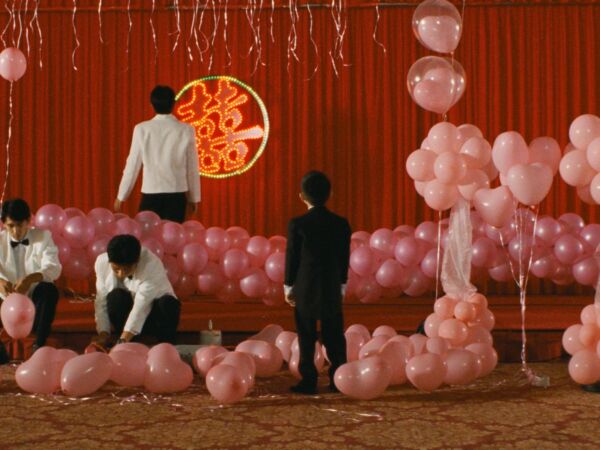
At the end of the day, they are simply people trying their best to find their place in this world—figuring out how to face uncertainty and change, and how to live with the consequences of their decisions. While the film begins with a wedding, it ends with a funeral, creating a powerful full-circle moment. They continue living their lives, carrying new mistakes, confusions, and uncertainties ahead of them. Yet perhaps these very things are what lead us to more chances to understand ourselves.